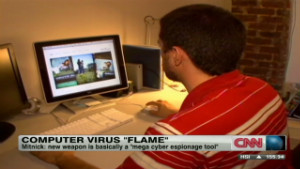
A massive, highly sophisticated piece of malware has been newly found
infecting systems in Iran and elsewhere and is believed to be part of a
well-coordinated, ongoing, state-run cyber-espionage operation.
The malware, discovered
by Russia-based anti-virus firm Kaspersky Lab, is an espionage toolkit
that has been infecting targeted systems in Iran, Lebanon, Syria, Sudan,
the West Bank and other places in the Middle East and North Africa for
at least two years.
Dubbed "Flame" by Kaspersky, the malicious code dwarfs Stuxnet --
the groundbreaking infrastructure-sabotaging malware
that is believed to have wreaked havoc on Iran's nuclear program in
2009 and 2010. Although Flame has both a different purpose and
composition than Stuxnet, and appears to have been written by different
programmers, its complexity, the geographic scope of its infections and
its behavior indicate strongly that a nation-state is behind Flame
rather than common cyber-criminals, marking it as yet another tool in
the growing arsenal of cyberweaponry.
The researchers say that
Flame may be part of a parallel project created by contractors who were
hired by the same nation-state team that was behind Stuxnet and its
sister malware, DuQu.
"Stuxnet and Duqu
belonged to a single chain of attacks, which raised cyberwar-related
concerns worldwide," said Eugene Kaspersky, CEO and co-founder of
Kaspersky Lab, in a statement. "The Flame malware looks to be another
phase in this war, and it's important to understand that such cyber
weapons can easily be used against any country."
Early
analysis of Flame by the Lab
indicates that it's designed primarily to spy on the users of infected
computers and steal data, including documents, recorded conversations
and keystrokes. It also opens a backdoor to infected systems to allow
the attackers to tweak the toolkit and add new functionality.
The malware, which is 20 megabytes when all of its modules are installed, contains multiple libraries,
SQLite3 databases,
various levels of encryption -- some strong, some weak -- and 20
plug-ins that can be swapped in and out to provide various functionality
for the attackers. It even contains some code that is written in the
LUA programming language -- an uncommon choice for malware.
Kaspersky Lab is calling it "one of the most complex threats ever discovered."
"It's pretty fantastic and incredible in complexity," said Alexander Gostev, chief security expert at Kaspersky Lab.
Flame appears to have been operating in the wild as early as March 2010, though it remained undetected by antivirus companies.
"It's a very big chunk
of code. Because of that, it's quite interesting that it stayed
undetected for at least two years," Gostev said. He noted that there are
clues that the malware may actually date back to as early as 2007,
around the same time that Stuxnet and DuQu are believed to have been
created.
Gostev says that because of its size and complexity, complete analysis of the code may take years.
"It took us half-a-year
to analyze Stuxnet," he said. "This is 20 times more complicated. It
will take us 10 years to fully understand everything."
Kaspersky discovered the malware about two weeks ago after the
United Nations International Telecommunications Union
asked the lab to look into reports in April that computers belonging to
the Iranian Oil Ministry and the Iranian National Oil Co. had been hit
with malware that was stealing and deleting information from the
systems. The malware was named alternatively in news articles as
"Wiper" and
"Viper," a discrepancy that may be due to a translation mixup.
Kaspersky researchers
searched through their reporting archive, which contains suspicious
filenames sent automatically from customer machines so the names can be
checked against whitelists of known malware, and found an MD5 hash and
filename that appeared to have been deployed only on machines in Iran
and other Middle East countries. As the researchers dug further, they
found other components infecting machines in the region, which they
pieced together as parts of Flame.
Kaspersky, however, is
currently treating Flame as if it is not connected to Wiper/Viper, and
believes it is a separate infection entirely. The researchers dubbed the
toolkit "Flame" after the name of a module inside it.
Flame is named after one of the main modules inside the toolkit.
Among Flame's many
modules is one that turns on the internal microphone of an infected
machine to secretly record conversations that occur over Skype or in the
computer's near vicinity; a module that turns Bluetooth-enabled
computers into a Bluetooth beacon, which scans for other
Bluetooth-enabled devices in the vicinity to siphon names and phone
numbers from their contacts folder; and a module that grabs and stores
frequent screenshots of activity on the machine, such as
instant-messaging and e-mail communications, and sends them via a covert
SSL channel to the attackers' command-and-control servers.
The malware also has a
sniffer component that can scan all of the traffic on an infected
machine's local network and collect usernames and password hashes that
are transmitted across the network. The attackers appear to use this
component to hijack administrative accounts and gain high-level
privileges to other machines and parts of the network.
Flame does contain a
module named Viper, adding more confusion to the Wiper/Viper issue, but
this component is used to transfer stolen data from infected machines to
command-and-control servers. News reports out of Iran indicated the
Wiper/Viper program that infected the oil ministry was designed to
delete large swaths of data from infected systems.
Kaspersky's researchers
examined a system that was destroyed by Wiper/Viper and found no traces
of that malware on it, preventing them from comparing it to the Flame
files. The disk destroyed by Wiper/Viper was filled primarily with
random trash, and almost nothing could be recovered from it, Gostev
said. "We did not see any sign of Flame on that disk."
Because Flame is so big,
it gets loaded to a system in pieces. The machine first gets hit with a
6-megabyte component, which contains about a half-dozen other
compressed modules inside. The main component extracts, decompresses and
decrypts these modules and writes them to various locations on disk.
The number of modules in an infection depends on what the attackers want
to do on a particular machine.
Once the modules are
unpacked and loaded, the malware connects to one of about 80
command-and-control domains to deliver information about the infected
machine to the attackers and await further instruction from them. The
malware contains a hardcoded list of about five domains, but also has an
updatable list, to which the attackers can add new domains if these
others have been taken down or abandoned.
While the malware awaits
further instruction, the various modules in it might take screenshots
and sniff the network. The screenshot module grabs desktop images every
15 seconds when a high-value communication application is being used,
such as instant messaging or Outlook, and once every 60 seconds when
other applications are being used.
Although the Flame
toolkit does not appear to have been written by the same programmers who
wrote Stuxnet and DuQu, it does share a few interesting things with
Stuxnet.
Stuxnet is believed to
have been written through a partnership between Israel and the United
States, and was first launched in June 2009. It is widely believed to
have been designed to sabotage centrifuges used in Iran's uranium
enrichment program. DuQu was an espionage tool discovered on machines in
Iran, Sudan, and elsewhere in 2011 that was designed to steal documents
and other data from machines. Stuxnet and DuQu appeared to have been
built on the same framework, using identical parts and using similar
techniques.
But Flame doesn't resemble either of these in framework, design or functionality.
Stuxnet and DuQu were
made of compact and efficient code that was pared down to its
essentials. Flame is 20 megabytes in size, compared to Stuxnet's 500
kilobytes, and contains a lot of components that are not used by the
code by default, but appear to be there to provide the attackers with
options to turn on post-installation.
"It was obvious DuQu was
from the same source as Stuxnet. But no matter how much we looked for
similarities (in Flame), there are zero similarities," Gostev said.
"Everything is completely different, with the exception of two specific
things."
One of these is an
interesting export function in both Stuxnet and Flame, which may turn
out to link the two pieces of malware upon further analysis, Gostev
said. The export function allows the malware to be executed on the
system.
Also, like Stuxnet,
Flame has the ability to spread by infecting USB sticks using the
autorun and .lnk vulnerabilities that Stuxnet used. It also uses the
same print spooler vulnerability that Stuxnet used to spread to
computers on a local network. This suggests that the authors of Flame
may have had access to the same menu of exploits that the creators of
Stuxnet used.
Unlike Stuxnet, however,
Flame does not replicate automatically by itself. The spreading
mechanisms are turned off by default and must be switched on by the
attackers before the malware will spread. Once it infects a USB stick
inserted into an infected machine, the USB exploit is disabled
immediately.
This is likely intended
to control the spread of the malware and lessen the likelihood that it
will be detected. This may be the attackers' response to the
out-of-control spreading that occurred with Stuxnet and accelerated the
discovery of that malware.
It's possible the
exploits were enabled in early versions of the malware to allow the
malware to spread automatically, but were then disabled after Stuxnet
went public in July 2010 and after the .lnk and print spooler
vulnerabilities were patched. Flame was launched prior to Stuxnet's
discovery, and Microsoft patched the .lnk and print spooler
vulnerabilities in August and September 2010.
Any malware attempting
to use the vulnerabilities now would be detected if the infected
machines were running updated versions of antivirus programs. Flame, in
fact, checks for the presence of updated versions of these programs on a
machine and, based on what it finds, determines if the environment is
conducive for using the exploits to spread.
The researchers say they
don't know yet how an initial infection of Flame occurs on a machine
before it starts spreading. The malware has the ability to infect a
fully patched Windows 7 computer, which suggests that there may be a
zero-day exploit in the code that the researchers have not yet found.
The earliest sign of
Flame that Kaspersky found on customer systems is a filename belonging
to Flame that popped up on a customer's machine in Lebanon on August 23,
2010. An Internet search on the file's name showed that security firm
Webroot had reported the same filename appearing on a computer in Iran
on March 1, 2010. But online searches for the names of other unique
files found in Flame show that it may have been in the wild even earlier
than this. At least one component of Flame appears to have popped up on
machines in Europe on December 5, 2007, and in Dubai on April 28, 2008.
Kaspersky estimates that
Flame has infected about 1,000 machines. The researchers arrived at
this figure by calculating the number of its own customers who have been
infected and extrapolating that to estimate the number of infected
machines belonging to customers of other antivirus firms.
All of the infections of
Kaspersky customers appear to have been targeted and show no indication
that a specific industry, such as the energy industry, or specific
systems, such as industrial control systems, were singled out. Instead,
the researchers believe Flame was designed to be an all-purpose tool
that so far has infected a wide variety of victims. Among those hit have
been individuals, private companies, educational institutions and
government-run organizations.
Symantec, which has also
begun analyzing Flame (which it calls "Flamer"), says the majority of
its customers who have been hit by the malware reside in the West Bank,
Hungary, Iran, and Lebanon. They have received additional reports from
customer machines in Austria, Russia, Hong Kong and the United Arab
Emirates.
Researchers say the
compilation date of modules in Flame appear to have been manipulated by
the attackers, perhaps in an attempt to thwart researchers from
determining when they were created.
"Whoever created it was
careful to mess up the compilation dates in every single module," Gostev
said. "The modules appear to have been compiled in 1994 and 1995, but
they're using code that was only released in 2010."
The malware has no kill
date, though the operators have the ability to send a kill module to it
if needed. The kill module, named browse32, searches for every trace of
the malware on the system, including stored files full of screenshots
and data stolen by the malware, and eliminates them, picking up any
breadcrumbs that might be left behind.
"When the kill module is activated, there's nothing left whatsoever," Gostev said.
(UPDATE noon ET: Iran's Computer Emergency Response Team announced on Monday
that it had developed a detector to uncover what it calls the "Flamer"
malware on infected machines and delivered it to select organizations at
the beginning of May. It has also developed a removal tool for the
malware. Kaspersky believes the "Flamer" malware is the same as the
Flame malware its researchers analyzed.)