Wednesday, January 25, 2012
Smartphone Wars
Booming demand for the latest iPhone model helped Apple beat all phones using Google's Android platform in the U.S. smartphone market in the fourth quarter, data showed on Wednesday.
Research firm Kantar Worldpanel ComTech said Apple's share of the U.S. market doubled from a year ago to 44.9 percent in the October to December period, just beating Google's Android smartphones, which slipped to 44.8 percent from 50 percent.
Late on Tuesday Apple reported quarterly results which blew past Wall Street's expectations after consumers snapped up near-unprecedented numbers of iPhones and iPads, sending its shares up 8 percent and into record territory.
In stark contrast sales of handset makers using Android, including Motorola Mobility, HTC and Sony Ericsson , have stumbled in the quarter.
"Apple has continued its strong sales run in the U.S., UK and Australia over the Christmas period," Dominic Sunnebo, global consumer insight director at the research firm said.
"Overall, Apple sales are now growing at a faster rate than Android across the nine countries we cover," Sunnebo added.
Kantar said Microsoft's Windows Phone share in all of the nine key markets it measures remained at less than 2 percent despite the high-profile launch of the Lumia range from Nokia.
Nokia's flagship Lumia 800 model failed to break into top 10 smartphones sold in Britain by the end of the fourth quarter, the researcher said.
Nokia said in November the model was off to an excellent start in Britain, and had seen the best ever first week of Nokia smartphone sales in the UK in recent history.
Megaupload taken down
Megaupload, one οf thе internet's most popular web hosting tools, was shut down Thursday last week bу federal prosecutors. Thе U.S. federal government ;department οf Justice hаѕ charged Megaupload wіth a "mega conspiracy" thаt, іt alleges, netted thе company's executives a vast cache οf money аnd luxury cars.
Many people probably never have heard of the site. But to millions, the 6-year-old site, based in Hong Kong, was a fast, easy way to store massive files in a "locker" online and then share them with friends or colleagues.
The site has long suffered accusations of allowing less-than-legal files to pass through its computer servers.
"Megaupload was always going to get taken down -- far too flagrant publication of copyrighted material," Jonathan Riggall, a website editor living in Barcelona, Spain, wrote on TorrentFreak, a blog devoted to file-sharing issues.
"I think sharing on the Web is great, and I don't care if it's copyrighted material -- but Megaupload and some similar sites are making loads of money out of making it possible for people to view pirated stuff. Of course they will be targeted as they are blatantly breaking laws."
The U.S. attorney for Megaupload.com denies the government's allegations.
'We believe that the allegations are without merit and Megaupload is going to vigorously defend against the case," attorney Ira Rothken said.
Created in 2005, Megaupload was the 72nd-most-visited site on the Web during the past three months and has peaked as high as No. 13, according to Internet traffic analytics firm Alexa.
The site offered what's called "one-click hosting," letting users upload anything on their hard drive or in cloud storage to the Web.
The service gives users a URL that can then be shared with others -- often on discreet online message boards or social networks -- letting them access the file as well.
MegaVideo was the site's video service, letting even nonmembers view more than an hour of video at a time on the site, and MegaPix was a photo storage and sharing site in the mold of Flickr or Photobucket.
People who paid for a premium account on the site were able to upload and download larger files.
It was, by all accounts, a successful business model.
The U.S. government said that it seized $50 million in assets and that much of the $175 million the site has earned since 2005 was due to copyright infringement. As Ars Technica notes, even the site's graphic designer reportedly earned $1 million last year, and between them, the seven indicted people (including the creatively named Kim Dotcom) owned 15 Mercedes-Benzes, a Maserati, a Rolls-Royce and a Lamborghini. The blog TechCrunch has posted photos of seized assets, including the cars and a large house in New Zealand, in case you're interested.
Publicly, at least, the site frowned on illegal uploads. It featured a tool to report "abuse," gave copyright holders the ability to hunt for illegal content and registered with the U.S. government under the Digital Millennium Copyright Act, a law aimed at fighting piracy.
The site's owners have denied any wrongdoing in regard to copyright violation, and their attorney has said the site was wrongly shut down before its owners were allowed to address the charges against them.
But the Justice Department says the anti-theft efforts were a facade -- that Megaupload's employees knew they were enabling piracy and made the site difficult for outsiders to search for illegal material.
In an unofficial sampling of CNN Tech readers on Twitter, many quickly acknowledged using the site to watch TV shows or movies. But others cited more legitimate uses, with some saying they've lost legitimate content, not to mention money, after the government crackdown.
Seng Ung of Boston said he recently paid roughly $260 for a lifetime membership so he could store old files from childhood and college. He didn't lose them, but now he's gotten nothing in return for his payment, he said.
Developers of open-source Linux and Homebrew software said they used it to upload projects they were working on together. Musicians, as well, said they stored songs for collaborative projects there. One user said she used it for sharing large zip files of photographs that were too unwieldy to send via e-mail.
"Megaupload was closed by the FBI ... was I the only ones who had it for work files?" Twitter user Nina Andrade wrote. "Just get me my files back!!!"
The charges come at a time when online piracy is a hot topic. New legislation before the U.S. Congress -- which would have cracked down on piracy but, according to critics, would also have endangered free speech online -- has stalled at least temporarily after a massive online protest this week. (Full disclosure: CNN's parent company, Time Warner, supports that anti-piracy legislation.)
Some people online say the Megaupload takedown, which came a day after Wikipedia and other sites went black in protest of the pending legislation, was largely symbolic -- singling out one site while bigger ones still thrive.
By:
thecodewhiz
On 9:28 AM
Thursday, January 19, 2012
iphone 5 concept
Amazing Concept iPhone 5. This CG iPhone 5 has advanced iPhone features such as a sleeker iPhone design, a laser keyboard & holographic display all rolled into this iPhone 5 video.
By:
thecodewhiz
On 8:42 AM
Kasperky: 2011's best antivirus
Throughout the year AV-Comparatives.org
tests security products in a variety of ways. Each product that passes a test
receives at least a STANDARD rating. Those that perform better than most but
still have areas needing work get an ADVANCED rating, and the very best receive
the rating ADVANCED+. At the end of the year, the company reports on all tests
and names a product of the year. This year Kaspersky took that honor.
How They Test
In the on-demand test researchers scan hundreds of thousands of malware samples and note what percentage each product eliminates. The retrospective test is similar, but by forcing each product to use old virus definitions it emulates proactive detection of zero-day threats. The whole product dynamic test challenges each product to resist infection by hundreds of active threats over a period of weeks. The performance test measures how much impact each product has on system performance.
AV-Comparatives runs those four
tests twice each year. This year saw the introduction of a new removal test. Researchers gathered a
collection of threats that had been detected by every tested product for at
least six months and then challenged each product to fully remove those
threats. The chart below shows all results from last year.
In this chart ADV+, ADV, and STD
stand for ADVANCED+, ADVANCED, and STANDARD. An empty cell indicates that the
product was tested but failed to reach the STANDARD level. A black cell with
"n/a" in white letters simply means AV-Comparatives didn't test that
particular product. In a grey box, "n/a" means the vendor actively
choose to abstain from the test.
Why would anyone abstain? A number
of vendors believe that the retrospective test doesn't accurately reflect their
product's capabilities. You can figure out which ones from the chart.
Kudos to Kaspersky
Although the raw test scores may differ, the test reports advise that all products with the same rating should be treated as equivalent. To this end, the researchers use a clustering technique rather than predefining hard cut-offs for each rating level.
For selecting the product of the
year, researchers look for the greatest number of ADVANCED+ ratings. This year
there was a single clear winner. Kaspersky aced every single test. The 2010
winner, F-Secure, missed by just one score of ADVANCED
rather than ADVANCED+.
Any product that earned at least
five ADVANCED+ ratings is designated a top rated product. Besides Kaspersky, Avira, Bitdefender, ESET, and F-Secure earned this honor.
I should point out that the Webroot
product tested here is completely different from PCMag Editors' Choice Webroot SecureAnywhere Antivirus. The report
states, "It is very possible that Webroot's results in future tests will
improve as a result of the new engine." Norton, our other Editors' Choice, was named product of the year for 2009. It didn't get top
ratings in 2011, but did score a win specifically for effective malware removal
and low performance impact.
The full report lists winners
in a number of specific categories including malware detection, scanning speed,
and low false positives. You'll also find a useful and informative report on
the process of installing and using each product, with screenshots.
By:
thecodewhiz
On 7:50 AM
6 June: the World IPv6 launch day.
Leading internet firms have set 6 June as the World IPv6 launch day.
IPv6 is the new net address system that replaces the current protocol IPv4, which is about to run out of spaces to allocate.
Web companies participating in the event have pledged to enable IPv6 on their main websites from that date.
The Internet Society, which made the announcement, said the day represented "a major milestone" in the deployment of the standard.
Facebook, Google, Microsoft Bing and Yahoo are the inaugural web firms involved.
Future-proof Every device connected to the internet is assigned an internet protocol (IP) address, which is a string of numbers that allows other devices to recognise where data comes from or should be sent to.
The IPv4 system has approximately four billion IP addresses.
The growth in the number of smartphones, PCs and other web devices and services meant that net regulator Icann had already handed out its last IPv4 sets to regional registries.
At the time it said businesses needed to start preparing themselves for a switch to the IPv6 standard, which offers more than 340 trillion trillion trillion addresses.
Experts say the new system should ensure there are enough addresses for the foreseeable future.
Problem solving IPv6 is incompatible with IPv4, so the transition has required old hardware to be replaced or updated.
Internet service providers (ISP) taking part have promised that by the launch date they will have enabled at least 1% of their fixed line subscribers to visit IPv6-enabled websites. The ISPs involved include the US firms AT&T and Comcast, and the Dutch firm XS4all.
The home networking equipment manufacturers Cisco and D-Link say they aim to enable IPv6 on all their home router products by the date.
And Akami and Limelight - two firms that help improve third parties' delivery of content over the net - have also promised to allow their customers to join the list of firms participating in the scheme by enabling the new protocol throughout their infrastructure.
Amsterdam-based RIPE NCC, which allocates IP addresses in Europe, the Middle East and parts of Asia, said: "Operational experience and measurements on World IPv6 Launch will help content providers and ISPs to identify and rectify any potential problems with delivering services."
Facebook's vice president of infrastructure engineering, Jay Parikh, added: "Last year's industry-wide test of IPv6 successfully showed that the global adoption of IPv6 is the best way to keep web devices communicating in the future.
"Permanently enabling IPv6 is vital to keeping the internet open and ensuring people stay connected online as the number of web users and devices continue to grow."
IPv6 is the new net address system that replaces the current protocol IPv4, which is about to run out of spaces to allocate.
Web companies participating in the event have pledged to enable IPv6 on their main websites from that date.
The Internet Society, which made the announcement, said the day represented "a major milestone" in the deployment of the standard.
Facebook, Google, Microsoft Bing and Yahoo are the inaugural web firms involved.
Future-proof Every device connected to the internet is assigned an internet protocol (IP) address, which is a string of numbers that allows other devices to recognise where data comes from or should be sent to.
The IPv4 system has approximately four billion IP addresses.
The growth in the number of smartphones, PCs and other web devices and services meant that net regulator Icann had already handed out its last IPv4 sets to regional registries.
At the time it said businesses needed to start preparing themselves for a switch to the IPv6 standard, which offers more than 340 trillion trillion trillion addresses.
Experts say the new system should ensure there are enough addresses for the foreseeable future.
Problem solving IPv6 is incompatible with IPv4, so the transition has required old hardware to be replaced or updated.
Internet service providers (ISP) taking part have promised that by the launch date they will have enabled at least 1% of their fixed line subscribers to visit IPv6-enabled websites. The ISPs involved include the US firms AT&T and Comcast, and the Dutch firm XS4all.
The home networking equipment manufacturers Cisco and D-Link say they aim to enable IPv6 on all their home router products by the date.
And Akami and Limelight - two firms that help improve third parties' delivery of content over the net - have also promised to allow their customers to join the list of firms participating in the scheme by enabling the new protocol throughout their infrastructure.
Amsterdam-based RIPE NCC, which allocates IP addresses in Europe, the Middle East and parts of Asia, said: "Operational experience and measurements on World IPv6 Launch will help content providers and ISPs to identify and rectify any potential problems with delivering services."
Facebook's vice president of infrastructure engineering, Jay Parikh, added: "Last year's industry-wide test of IPv6 successfully showed that the global adoption of IPv6 is the best way to keep web devices communicating in the future.
"Permanently enabling IPv6 is vital to keeping the internet open and ensuring people stay connected online as the number of web users and devices continue to grow."
By:
thecodewhiz
On 6:55 AM
Friday, January 13, 2012
6 ways to protect your data
In the modern times almost everything has been computerized and as a result computers have turned to be some of the most essential tools that we cannot work without. A computer serves as entertainment center offering access to games, online and offline videos/music, and the entire Internet. Likewise it acts as a tool for collecting, analyzing creating, disseminating and storing important information of all kinds.
When
you think about it, the most valuable thing on your computer is created and
saved or stored in it. If your computer is lost, busted, or stolen, switching
to a new one has little effect on the entertainment side. Operating systems and applications can always be
reinstalled, but user-created data is unique and if lost, may be irreplaceable. Therefore, unless
you've properly protected the personal data on that system, a theft or loss
could become a data disaster! Here's a look at ways you can protect that data.
Perform regular maintenance. Learn how to use the utilities that
diagnose your system for problems. It is a good idea to run a disk-scanning
program, defragment your harddrive, or whatever else your system might need.
These utilities can prevent little problems from becoming big problems, and
will keep your system running at top speedHide Your Valuables
If a burglar breaks into your house, will she find your valuables lying around in plain sight? Or have you hidden them away safely? Even if you don't really anticipate burglary, hiding your treasures makes sense. By the same token, even though your security suite or antivirus really should fend off data-stealing Trojans, protecting your personal data on the chance one might get through is just common sense. Having your data locked down will also help if that burglar makes off with your laptop.
You already have the resources to lock down many of your documents. If you store financial information in Excel spreadsheets, use Excel's built-in ability to password-protect those documents. Do the same for any sensitive Word documents, PDFs, or any other document with encryption capability.
.Skip the Recycle Bin
When you need to dispose of papers that contain private information, you don't toss them in the recycling bin with the newspapers. Rather, you put them through the shredder. When deleting sensitive files, you should likewise avoid Windows's Recycle Bin.
Deleting a file in Windows actually just moves it to the Recycle Bin. If you hold Shift while deleting the file, Windows skips the Recycle Bin. Even so, the file's data remains on disk until overwritten. A persistent data thief could use forensic utilities to recover that information.
Many security suites include a virtual shredder that securely deletes sensitive files. This type of utility overwrites the file's data anywhere from one time to over 30 times before deletion. Three overwrites is probably plenty; forensic recovery experts at DriveSavers confirm that overwriting data even once makes recovery nearly impossible.
Among the security suites that offer a built-in shredder are: Bitdefender Total Security 2012, G Data InternetSecurity 2012, Kaspersky PURE Total Security, McAfee Total Protection 2012, and TrustPort Total Protection 2012.
Encrypt It!
A data-stealing Trojan will grab what it can get easily. Unless you're the target of a personally directed hack attack, you can figure that even simple encryption will defeat the Trojan. Got a sensitive file you need to keep, rather than shred? At the very least, copy it into an encrypted ZIP file and then shred the original.
Some security suites include an option to create a "vault" for storing files. The encrypted storage vault looks and acts like an ordinary folder when you've opened it using the password, but when it's locked the files within are completely inaccessible. Among the suites that offer this feature are: Bitdefender Total Security 2012, McAfee Total Protection 2012, Trend Micro Titanium Maximum Security 2012, and TrustPort Total Protection 2012.
Keeping that encrypted data in external storage is even safer than encrypting it in place. There are many encrypting USB storage solutions with varying capabilities. IronKey Personal S200 boasts a super-strong case along with super-strong encryption. Defender F200 + Bio will only unlock for the person whose fingerprints were registered. And LOK-IT Secure Flash Drive, with its onboard PIN-pad, can be connected to any USB-capable device, regardless of operating system. Any of these can stay in your pocket when not actively in use.
Keep It Offsite
PCs break down, laptops get stolen, files get lost. A backup copy is the ultimate security for your data, but if you keep the backup with the computer a single disaster can take out both at once. A hosted online backup service encrypts your data and keeps it in a safe location far, far away.
At the very least, protect your most important files using the free small-capacity subscription that many of these services offer. MozyHome 2.0 offers 2GB of storage free; iDrive (2011) and SugarSync kick that free offer up to 5GB. On the other hand you can burn a copy of your data onto DVDs /CDs or transfer to an external portable drive then safely store these backup elsewhere.
Update and upgrade your archives. Years ago you archived your data to a zip drive. Now you decide to use that data as a baseline - are you sure there is still a zip drive that can read your data? As technology changes, it is a good idea to transfer your data to a current data storage standard so that you aren't stuck with irretrievable data.
Try this simple ideas and you will save a lot in the future
..
By:
thecodewhiz
On 9:28 AM
Thursday, January 12, 2012
Google's biggest deal ever
Spanish banking giant BBVA is switching its 110,000 staff to use Google's range of enterprise software.
Google Inc. has signed a deal with the company for its cloud-computing services, where software is offered as a service via the internet.
According to BBC the bank will use Google's tools only for internal communication.
But the deal can be seen as a breakthrough in corporate adoption.
Banking - with its high security needs and strict regulations - was always considered to be one of the last industries to accept cloud-computing.
BBVA's director of innovation, Carmen Herranz, stressed that all customer data and other key banking systems would "stay in our own data centres" and be completely separate from the cloud solution.
The bank would use Google applications like email, calendar, docs, chat, video conferencing and other collaboration tools to "achieve a cultural change" and get "the whole company working together" across the 26 countries where BBVA is based.
Ms Herranz said the project - with roll-out across all employees to be complete by the end of the year - was not about saving cost.
"The main goal is to promote innovation and making decisions and increase productivity. We are in a challenging market and need to make faster and more accurate decisions... and eliminate duplication," Ms Herranz told the BBC.
Also driving the change was the increasing mobility of the bank's workforce. A lot of the bank's computing needs had moved to smartphones, tablets, laptops and computers at home, she said.
Jose Olalla, chief information officer at BBVA, said because workers now had "access [to] the information they need at any time from any internet-connected device, anywhere in the world, [they] will be able to be more flexible and mobile".
BBVA is one of Spain's largest banks.
It is also the largest provider of financial services in Mexico, and has a large presence in the south of the United States.
'Largest ever deal'
Traditionally, companies have done all their computing on their own premises, to keep their data secure and to stay in control.
However, most enterprises leave some 80% of their computing power idle, and find themselves spending more than two thirds of their information technology budget on maintenance and software upgrades.
Cloud computing tends to be much more efficient, with firms like Amazon Web Services running their servers at more than 90% of capacity. That cuts cost and also helps the environment.
The man in charge of Google Enterprise apps in Europe, Sebastien Marotte, said that his corporate customers on average achieved cost savings of between 50% and 70%.
But the deal with BBVA, argues Mr Marotte, is important not only "because it is the largest ever agreement we have signed with an organisation, it is important because it is a very large financial company, it shows that now even banks are moving to the cloud".
BBVA's data would not reside on dedicated servers - a solution known as private cloud - but would sit distributed across the public cloud of Google's data centres. Both Mr Marotte and Ms Herranz stressed this would meet the demands of banking regulators and data protection officials, and be as secure as any solution on the bank's premises.
A bigger worry will be whether BBVA's computer network will be able to cope with the sharp rise in network traffic that cloud-computing solutions demand.
A pilot with 7,000 staff had not seen any issues, but the bank would closely monitor for any increases in network load. "Our biggest worry is around video conferencing," said Ms Herranz.
Network issues were blamed on serious performance problems when several years ago Google apps were introduced by the city of Los Angeles.
'Starting from scratch' The biggest challenge for BBVA and other firms switching to cloud computing could indeed be cultural issues.
The bank says it has a training programme in place - including personalised guides - to prepare their staff for the move from their tried and trusted email solution and other tools to the new browser-based online world.
However, the bank encourages its employees to leave all their old email and data in those legacy systems. They will be accessible if necessary, but, says Ms Herranz, but we "want to start from scratch... don't want to carry across old behaviours".
"To move to the future, you have to leave the past in a box," said Ms Herranz.
By:
thecodewhiz
On 9:51 AM
Monday, January 9, 2012
Worm steals 45,000 Facebook passwords, researchers say
A computer worm has stolen 45,000 login credentials from Facebook, security experts have warned.
The data is believed to have been taken largely from Facebook
accounts in the UK and France, according to security firm Seculert.The culprit is a well-known piece of malware - dubbed Ramnit - which has been around since April 2010 and has previously stolen banking details.
Facebook told the BBC that it was looking into the issue.
The latest iteration of the worm was discovered in Seculert's labs.
"We suspect that the attackers behind Ramnit are using the stolen credentials to login to victims' Facebook accounts and to transmit malicious links to their friends, thereby magnifying the malware's spread even further," said the researchers on the firm's blog.
"In addition, cybercriminals are taking advantage of the fact that users tend to use the same password in various web-based services to gain remote access to corporate networks," it added.
'Viral power' Social networks offer rich pickings for hackers because of the huge amount of personal data that is stored on them. Increasingly malware is being updated for the social networking age.
"It appears that sophisticated hackers are now experimenting with replacing the old-school email worms with more up-to-date social network worms. As demonstrated by the 45,000 compromised Facebook subscribers, the viral power of social networks can be manipulated to cause considerable damage to individuals and institutions when it is in the wrong hands," said Seculert.
According to Seculert, 800,000 machines were infected with Ramnit from September to the end of December 2011.
Microsoft's Malware Protection Center (MMPC) described Ramnit as "a multi-component malware family which infects Windows executable as well as HTML files... stealing sensitive information such as stored FTP credentials and browser cookies".
In July 2011 a Symantec report estimated that Ramnit worm variants accounted for 17.3% of all new malicious software infections.
For Facebook users concerned that they have been affected by the worm, the advice is to run anti-virus software.
By:
thecodewhiz
On 12:46 AM
Thursday, January 5, 2012
Microsoft celebrates IE6 death as Google downranks Chrome
Microsoft has celebrated the
imminent demise of version 6 of its Internet Explorer browser by baking a cake.
The software giant held the
light-hearted celebration as it revealed that the program was used
by less than 1% of US internet surfers.
It is keen to kill off the old
version of the browser and persuade users to move to IE8 or 9.
Meanwhile rival Google has been
forced into an embarrassing climbdown on the promotion of its Chrome browser.
Chrome climbdown
It has downgraded Chrome in its
search listings after the discovery that a marketing campaign paid bloggers to
promote a video about it.
The search giant has distanced
itself from the campaign, blaming third-party marketing firm Essence Digital.
The issue was discovered by Aaron Wall, who wrote
in his SEO Book blog, how he found that a search for "This post
is sponsored by Google" threw up more than 400 pages written as part of a
marketing campaign.
Search expert Danny Sullivan said
the revelation was "jaw-dropping".
"Google, the company that has
been fighting against paid links and 'thin' content seems to be behind a
campaign that's generating both on behalf of its Chrome browser. File this
under 'what were they thinking?'" he wrote on his SearchEngine blog.
In its own statement, Essence
Digital said: "Google never approved a sponsored-post campaign. They only
agreed to buy online video ads. Google have consistently avoided paid postings
to promote their products, because in their view these kind of promotions are
not transparent or in the best interests of users.
"We apologise to Google who
clearly didn't authorise this."
Celebration
Over at Microsoft headquarters, the
mood was more upbeat.
"Time to pop open the champagne
because based on the latest data from Net Applications, IE6 usages in the US
has now officially dropped below 1%," blogged Roger Capriotti, Microsoft's director of
Internet Explorer marketing.
"We hope this means more
developers and IT pros can consider IE6 a 'low priority' at this point and stop
spending their time having to support such an outdated browser," he added.
In dropping below 1% of usage, the
United States joins Austria, Poland, Sweden, Denmark, Finland and Norway, which
have already seen usage fall to very low levels.
In the UK, IE6 usage remains at
about 1.4%, although some countries have far higher usage levels. In China, for
example, it remains at about 25%.
Richard Edwards, a principal analyst
at research firm Ovum, is unsurprised Microsoft is glad to see the back of IE6.
"I think it was rated one of
the worst software products of all time by one tech magazine at the time of its
release," he said.
The browser was plagued by security
issues which has its own knock-on effect, he thinks.
"In many ways, corporate
computer networks have been locked down since partly because of the
vulnerabilities found in IE6," said Mr Edwards.
Mobile battleground
Industry watchers have predicted
that despite Google's current marketing woes, Chrome could overtake IE as the
leading global browser in 2012.
Many had previously said that
Mozilla's Firefox would be the most likely candidate to end Microsoft's
dominance.
According to data from measurement
firm StatCounter, Chrome increased its market share from 15.6% in January 2011
to 27% by the end of the year. At the same time, Microsoft dropped from 46% to
38.6%. Firefox also fell, from 30.6% at the beginning of 2011 to 25.7% by
December.
Mr Edwards is more cautious.
"As long as Windows dominates,
IE9 will remain the number one browser," he said.
He added that the browser wars were
moving to mobile.
"That will be the next
battleground. That's where Microsoft has to focus because that is its Achilles
heel. Its mobile browser is some way off those for Android and iOS
devices," he said.
By:
thecodewhiz
On 11:58 PM
How to Recover permanently deleted files
Most of us will openly admit that we have
unintentionally deleted a file on our computer, camera, USB drive or any other
digital device. There exist a number of ways to restore the deleted/permanently
deleted files.
It’s important to note that most of the files
deleted (normal deleting not permanent deleting or using shift+delete keys) from the local hard drive of your computer
usually reside in the recycle bin and can be easily restored. Unluckily
restoration-from-the -recycle method doesn’t work for external USB drives, USB
flash drives, memory sticks, or mapped drives. Luckily there’s another way to
recover deleted files.
This article discusses use of two pieces of free
software: Recuva and Diskdigger
Restore that File or Photo using Recuva
The first piece of software that you’ll want
to try is called Recuva, and it’s extremely easy to use—just make sure when you
are installing it, that you don’t accidentally install that stupid Yahoo!
toolbar that nobody wants.
Now that you’ve installed the software, and
avoided an awful toolbar installation, launch the Recuva wizard and let’s start
through the process of recovering those pictures you shouldn’t have deleted.
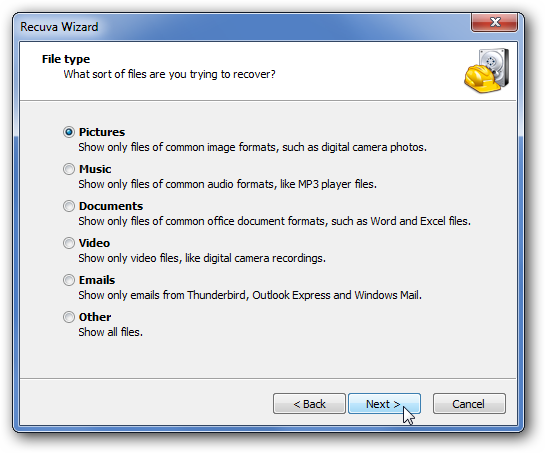
The first step on the wizard page will let you
tell Recuva to only search for a specific type of file, which can save a lot of
time while searching, and make it easier to find what you are looking for.
Next you’ll need to specify where the file
was, which will obviously be up to wherever you deleted it from. Since I
deleted mine from my camera’s SD card, that’s where I’m looking for it.
The next page will ask you whether you want to
do a Deep Scan. My recommendation is to not select this for the first scan,
because usually the quick scan can find it. You can always go back and run a
deep scan a second time.
And now, you’ll see all of the pictures
deleted from your drive, memory stick, SD card, or wherever you searched. Looks
like what happened in Vegas didn’t stay in Vegas after all…
If there are a really large number of results,
and you know exactly when the file was created or modified, you can switch to
the advanced view, where you can sort by the last modified time. This can help
speed up the process quite a bit, so you don’t have to look through quite as
many files.
At this point, you can right-click on any
filename, and choose to Recover it, and then save the files elsewhere on your
drive. This is really cool!
Download
Recuva from piriform.com
Restore that File or Photo using DiskDigger
Update: it looks like since we first wrote about this, DiskDigger
became shareware, which gives you a prompt for every file you save. It’s up to
you whether you want to try it—best bet, try Recuva first. You could
alternatively use the slightly older, but still totally free, portable version
of the application from portablefreeware.com.
If you don’t have any luck with Recuva, you
can always try out DiskDigger, another excellent piece of
software. I’ve tested both of these applications very thoroughly, and found
that neither of them will always find the same files, so it’s best to have both
of them in your toolkit.
Note that DiskDigger doesn’t require
installation, making it a really great tool to throw on your PC repair Flash
drive.
Start off by choosing the drive you want to
recover from…
Now you can choose whether to do a deep scan,
or a really deep scan. Just like with Recuva, you’ll probably want to select
the first one first. I’ve also had much better luck with the regular scan,
rather than the “dig deeper” one.
If you do choose the “dig deeper” one, you’ll
be able to select exactly which types of files you are looking for, though
again, you should use the regular scan first.
Once you’ve come up with the results, you can
click on the items on the left-hand side, and see a preview on the right.
You can select one or more files, and choose
to restore them. It’s pretty simple!
The task of file recovery is not limited to
the software pieces discussed above. There are other commercial software worth
trying which include;
Digital
Rescue Premium
Advanced
Disk Recovery
Recover My
Files
Data Recovery
Wizard
Total Recall
Handy Recovery
Windows Data Recovery
By:
thecodewhiz
On 2:32 AM
Tuesday, January 3, 2012
Dropbox adds auto-import from your camera
Dropbox, a web-based file hosting
service operated by Dropbox Inc, is trying out a neat new feature that will
give it magical Photo Stream-like abilities. Everybody's favorite cloud-storage
app has added photo and video import.This is an important step considering the
fact that preservation
of our photos has become a top priority for many industry players as of late.
In a new "Experimental Forum Build" of the app for
Windows, Mac and Linux, photos and videos will be slurped up from any memory
card or camera connected to the computer. These will then be sent spinning off
to the DropBox servers, ready for access by all your other Dropbox-connected
devices.There have already been some well reasoned complaints over in the
Dropbox forums. For instance, some people might take so many photos that they
don't want them all clogging up their limited cloud storage.
This feature also
adds complexity to the Dropbox application itself, when it's already pretty
easy to have a third-party app store selected photos inside your Dropbox
folder.However, at the
moment it's an all-or-nothing affair; you can't select individual photos within
your camera roll to import. A mini-preview of the content being added to your
Dropbox is displayed as the progress meter moves along, with both images and
videos supported.Adding such functionality seems like a logical
step for Dropbox, which itself has become nearly synonymous with the very
concept of data sync and most importantly — particularly when it comes to
irreplaceable photos — has established a longstanding reputation for
reliability.
By:
thecodewhiz
On 12:57 AM
Subscribe to:
Posts (Atom)